By Urban Shihemi, November 8, 2025
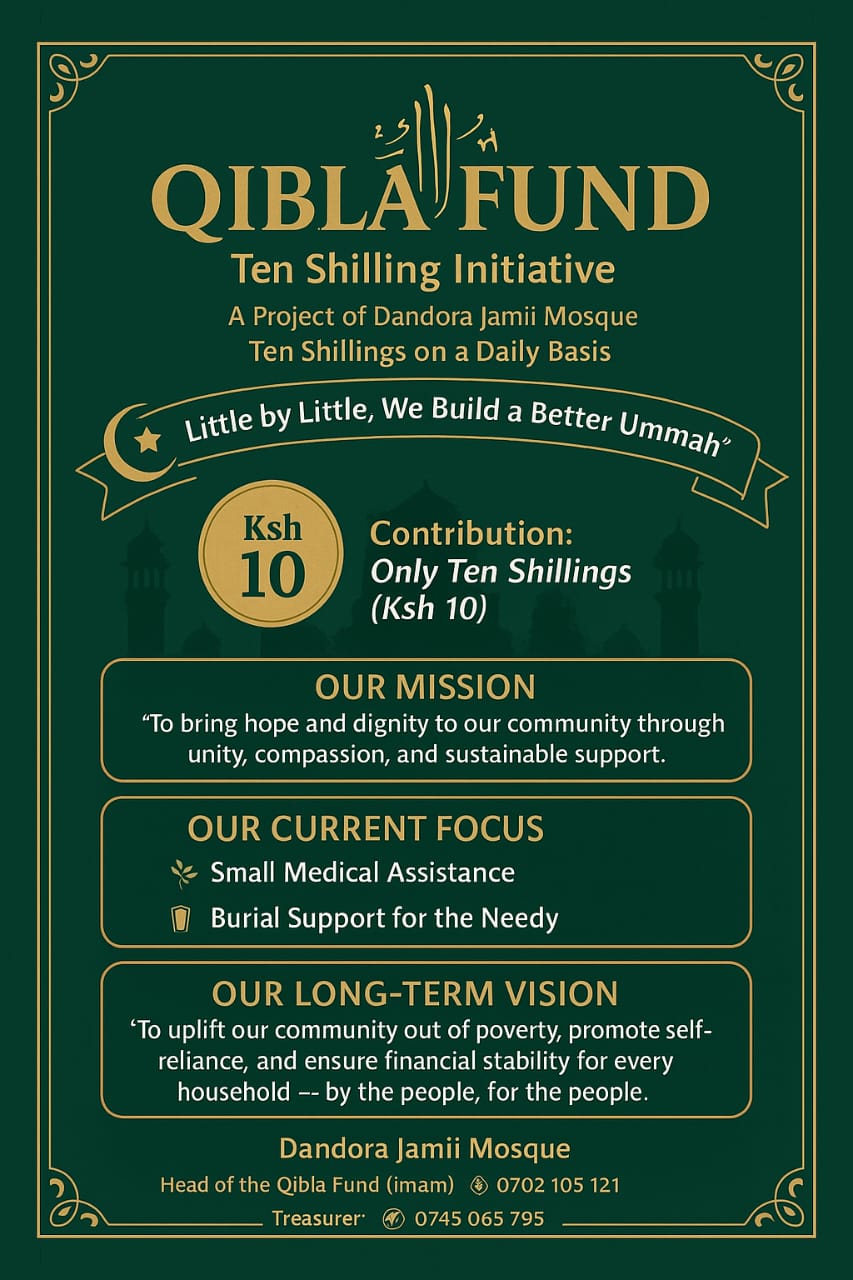
The Dandora Jamii Mosque in Nairobi has launched a unique community empowerment project dubbed the “Qibla Fund,” a ten-shilling contribution initiative aimed at supporting needy Muslims in areas such as medical assistance, burial support, and household welfare.
The program seeks to strengthen social welfare and self-reliance among local Muslim families through a simple, inclusive, and sustainable model where every member of the community contributes as little as ten shillings.
According to the Head of Qibla Fund, Sheikh Osman Ringo, the initiative embodies the Islamic principles of compassion, solidarity, and communal responsibility.
“The Qibla Fund is a project by the people, for the people. We want to create a safety net for our community a system where no one is left behind during times of need,” said Sheikh Ringo.
He explained that the fund’s primary focus areas include supporting the sick who cannot afford medical care, assisting families with burial expenses, and empowering vulnerable households to achieve self-reliance and financial independence.
“Our aim is to uplift the community out of poverty by encouraging every individual to take part in building a sustainable future. Even the smallest contribution, like ten shillings, can make a huge difference when we come together,” Sheikh Ringo added.
Many muslim families face significant challenges when it comes to paying hospital bills, clearing mortuary fees, and meeting burial expenses, especially in urban settlements such as Dandora, Eastleigh, Majengo, and Kibra among others.
For many low-income earners, unexpected illness or the death of a loved one often brings a heavy financial burden.
In most cases, families struggle to raise funds for medical treatment, post-hospital care, or mortuary charges, which can accumulate quickly in public and private hospitals.
The situation becomes even more difficult when the deceased’s body cannot be released until bills are settled, a challenge that affects dozens of Muslim families every month.
In the absence of structured community welfare systems, families often turn to well-established mosques such as Jamia Mosque Nairobi, Masjid Rahma in Hurligham, or South C Mosque, to appeal for financial help.
It’s this recurring challenge that inspired the Dandora Jamii Mosque to establish the Qibla Fund, a local, inclusive, and continuous contribution model designed to ease the burden of emergency costs and promote self-reliance among Muslims in the area.