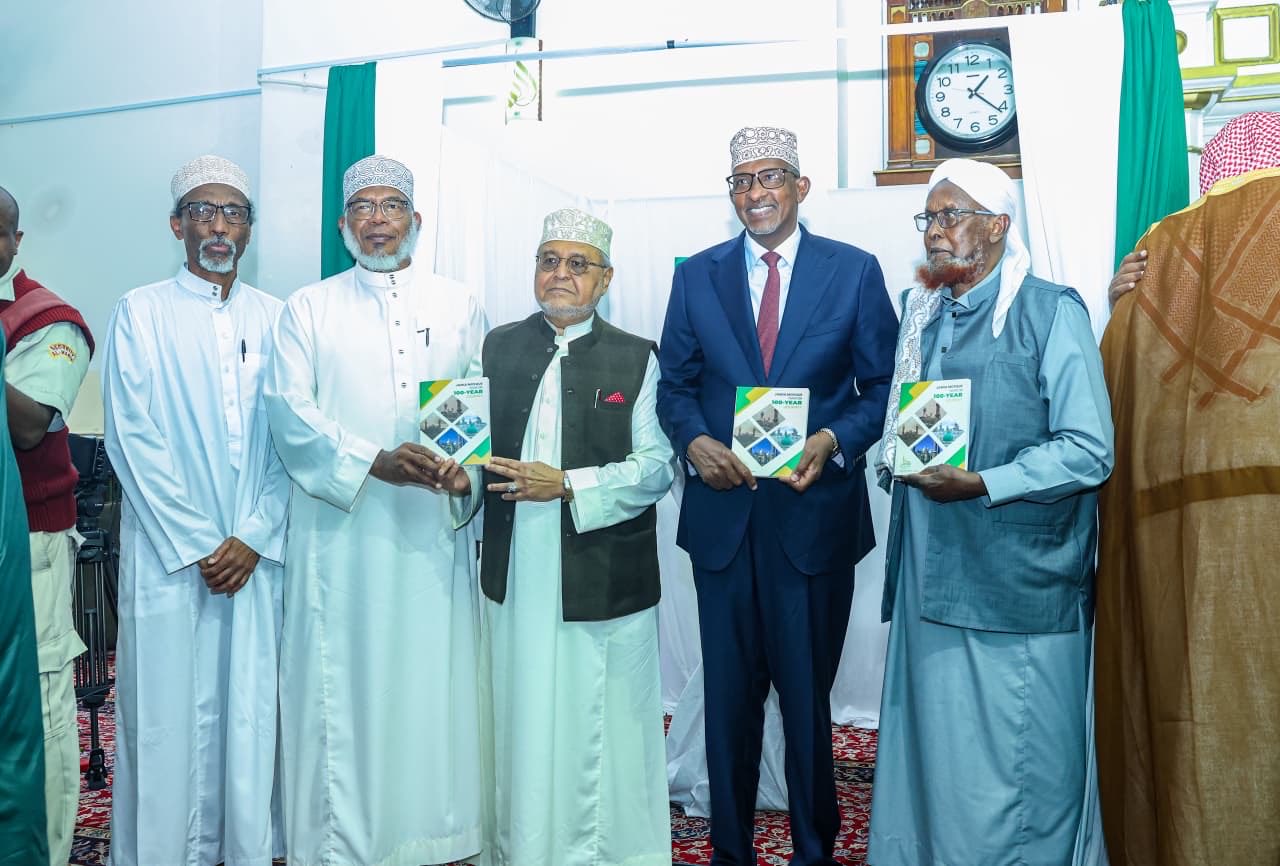
By Urban Shihemi, October 1 , 2025 Jamia Mosque Nairobi has unveiled a commemorative book celebrating its 100-year journey, marking a century of faith, community service, and leadership. The launch, held at the mosque, drew hundreds of Muslim faithful, including Health Cabinet Secretary Aden Duale, scholars (ulamaa), community leaders, and members of the Jamia Mosque Committee. The book, titled “Jamia Mosque Nairobi 100-Year Journey” and authored by Ghalib Yusuf Tamim, provides a detailed account of the mosque’s history from the laying of its foundation stone on September 7, 1925, to the completion of its construction in 1933. It explores the mosque’s early beginnings, architectural significance, expansion, and community impact, tracing its evolution into East Africa’s largest national mosque. The book is now available at Jamia Mosque Nairobi at a cost of KSh 1,500. Author Ghalib Yusuf Tamim expressed his gratitude to the Jamia Mosque leadership for the opportunity and support to undertake the project, noting that the publication will serve as a lasting heritage for future generations. Jamia Mosque Nairobi has long stood as a central hub for Islamic practice in East and Central Africa and continues to serve as a monument to the community’s resilience and faith. Addressing the gathering, Health Cabinet Secretary Aden Duale commended the mosque’s leadership for its steadfast role in promoting Islam and championing the interests of the Muslim ummah across Kenya.“Jamia Mosque is the mother of all mosques in the country, and I commend its leadership for their pivotal role in the spread of Islam and for being at the forefront in advocating for the interests and aspirations of the Muslim community,” he said. The CS further lauded Jamia Mosque Nairobi for its humanitarian work, saying its initiatives have greatly contributed to alleviating the suffering of the less privileged in society. Jamia Mosque Committee Chairman Sheikh Mohammed Osman Warfa reflected on the mosque’s historic construction, describing it as a monumental undertaking. He explained that the building stones were imported from India through the port of Mombasa and transported by rail to Nairobi. From the station, Indian railway workers carried each block on their shoulders to the construction site, where laborers worked under harsh colonial conditions and the constant threat of wild animals that roamed nearby. Sheikh Warfa reaffirmed the Committee’s commitment to continuing its core mission of Da’wah (propagation of Islam) to preserve and advance the legacy of the mosque’s founders. In recognition of dedicated service to Islam and the Muslim ummah, several individuals, including current and former staff members, committee members, and members of the Majlis Ulamaa, were honored with awards. Also in attendance were members of the Jamia Mosque Majlis, trustees, and board members of Jamia TV, among others